Condo & Apartment Leak Detection in Paterson, NJ
Managing a water intrusion event in a multi-unit residential building presents unique challenges that single-family homeowners rarely face. When an apartment ceiling leak Paterson residents notice begins to drip or stain the drywall, the actual source of the problem could be several feet away, or entirely located within the unit upstairs. Fast, accurate condo leak detection Paterson NJ property managers and residents rely on is crucial to preventing extensive structural damage across multiple dwellings.
Shared building plumbing systems, stacked bathrooms, and complex riser networks mean that water travels along the path of least resistance. It can run down structural columns, follow electrical conduits, or pool on subfloors before finally breaking through a ceiling below. Because of this, assuming that a visible stain directly corresponds to the leak's origin is often incorrect. Without proper diagnostic tools, repairing the drywall may only serve to temporarily mask a larger issue originating from a leak from unit above Paterson tenants are unaware of.
Paterson's dense multifamily properties, especially older buildings in the Downtown and South Paterson areas, frequently contain aging supply lines and shared drainage stacks. Locating the exact point of failure is necessary to minimize disruption to tenants and keep repair costs controlled.
Tracing Leaks Between Units
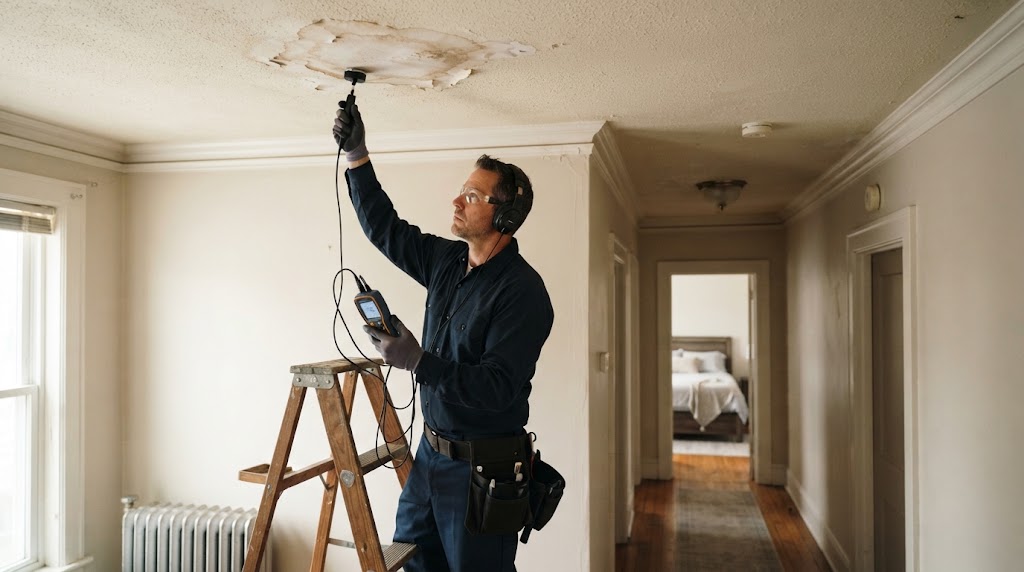
When dealing with cross-unit water intrusion, communication and access are critical. The detection process often requires access to the unit exhibiting the damage as well as the units adjacent or above. Our diagnostic approach involves isolating various fixtures and supply lines to systematically rule out potential causes.
We routinely investigate issues ranging from surface-level problems—such as a failing shower pan leak or deteriorated caulking—to more complex internal plumbing failures like a riser leak detection Paterson NJ buildings frequently require. We utilize thermal imaging and moisture mapping to track the spread of water between floors, and acoustic listening devices to detect pressurized pipe leaks within shared walls. This methodical process allows us to determine the actual source rather than relying on destructive guesswork.
After the source is located, we can clearly explain the findings to owners, property managers, or condominium/co-op boards. Clear documentation of the leak's origin helps facilitate smooth communication between affected neighbors and building management regarding responsibility and the necessary repair steps.
Frequently Asked Questions
What should I do if water is leaking from the apartment above?
If the leak is active and significant, try to alert the neighbor above you so they can stop using water or shut off their localized valves. Protect your belongings by moving them away from the affected area. Then, call a leak specialist and inform your property manager immediately.
Is it always the upstairs neighbor's fault?
Not necessarily. While a leak might be originating from the floor above, it could be a failure in a shared riser, a common drainage stack, or a hidden water leak within the wall cavity that neither tenant controls. Professional detection is required to determine the exact origin and responsibility.
How do you test for a leak if the upstairs unit is dry?
Water can originate from pipes located between the floors or inside the walls. The upstairs unit may appear completely dry on the surface while a pipe beneath their subfloor is actively leaking onto your ceiling. We use specialized non-invasive tools to detect moisture levels and temperature variances within the floor/ceiling assembly.
Can a leaking pipe cause an emergency?
Yes. If a shared main line or pressurized supply pipe bursts within the building structure, it can flood multiple units rapidly. In these situations, an emergency leak repair response is necessary to shut off the main water and halt the damage.