Hidden Water Leak Detection in Paterson, NJ
A water leak behind a wall or under a floor can cause significant damage to your property long before it becomes visible. Homeowners and business operators often realize there is a problem only when structural deterioration has already begun. Understanding the early warning signs of a hidden water leak Paterson properties may exhibit is the first step in minimizing costly repairs and protecting the integrity of your building.
One of the most common indicators is a surprisingly high water bill leak Paterson NJ residents might notice at the end of the month. If your usage habits haven't changed but the utility costs are spiking, an unseen pipe may be constantly running. Other signs include a water meter that continues to spin even when all fixtures and appliances are turned off. You might also notice damp patches on drywall, spreading ceiling stains, unexplained warm areas on the floor, or musty, mold-like odors that persist despite thorough cleaning.
Due to Paterson's varied architecture, including historic homes in the Eastside and densely packed commercial spaces Downtown, leaks can manifest differently depending on construction materials. Older buildings may have thicker walls or multiple layers of flooring that effectively conceal moisture until it reaches critical levels.
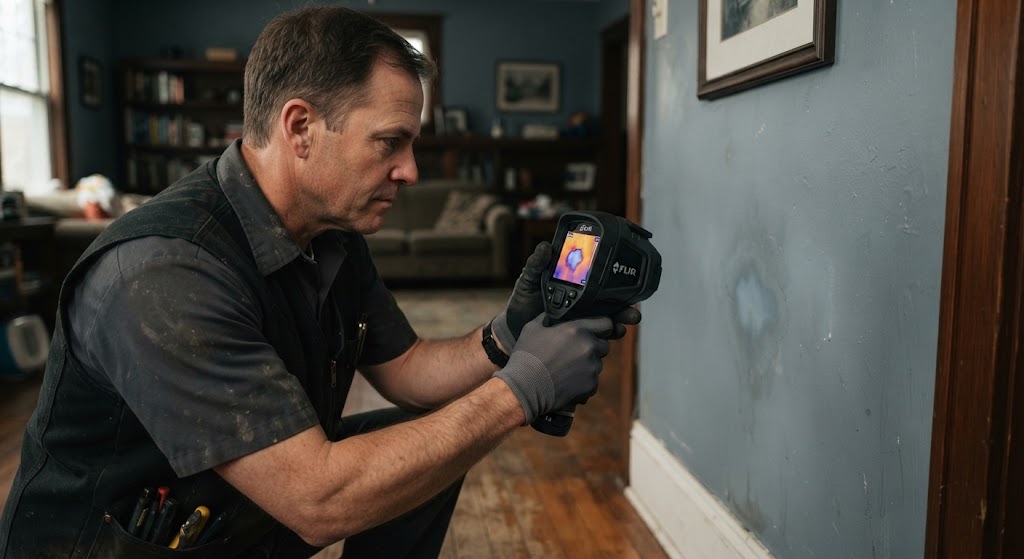
How We Pinpoint Hidden Leaks
Attempting to find a leak behind wall Paterson style without the proper tools often leads to unnecessary demolition. Guessing where the water is coming from based merely on where the stain appears is a common mistake; water naturally travels along beams, pipes, and the path of least resistance before pooling and showing itself.
To prevent destructive exploratory teardowns, our diagnostic process relies on advanced technology. We utilize acoustic listening equipment that can amplify the sound of water escaping under pressure within walls and under concrete slabs. Thermal imaging cameras help identify temperature anomalies caused by moisture hidden behind surfaces, providing a non-destructive visual map of the issue. Additionally, moisture mapping tools measure the exact moisture content of structural materials to accurately trace the leak back to its origin point. In certain complex scenarios, we may also utilize pressure testing or tracer gas to confirm the precise location of a breach.
While these methods are highly effective, the specific diagnostic approach depends entirely on the suspected leak and the property's construction. After the source is confidently identified, we can discuss the necessary steps for accessing the pipe and completing the repair. Often, this requires opening a small, targeted section of drywall rather than tearing down entire walls.
Frequently Asked Questions
How can I test my water meter for a leak?
Ensure no water is being used in the property—do not run the washing machine, dishwasher, or flush toilets. Locate your water meter and observe the low-flow indicator (often a small triangle or star wheel). If it is moving while all water is shut off, there is likely an active leak somewhere in the system. You can contact us to investigate further.
Will locating the leak damage my walls?
Our primary goal is non-invasive detection. By using acoustic and thermal technology, we aim to locate the exact source of the problem with minimal disruption. Accessing the pipe for repair will require some opening of the wall or ceiling, but pinpointing the leak first ensures this opening is as small and localized as possible.
Does a hidden leak mean the whole pipe needs replacement?
Not necessarily. Depending on the condition of the pipe and the cause of the failure, a localized pipe leak repair might be sufficient. However, if the leak is due to severe, widespread corrosion common in aging plumbing systems, larger sections may need to be addressed to prevent future failures.
Can a leak travel from an underground pipe?
Yes. If you suspect an issue outside the foundation, such as near the meter or street connection, you may need specific water line leak detection services to locate underground failures.